Stitched in Paint: Driving the Barn Quilt Trails That Turned County Roads Into a Gallery Crawl
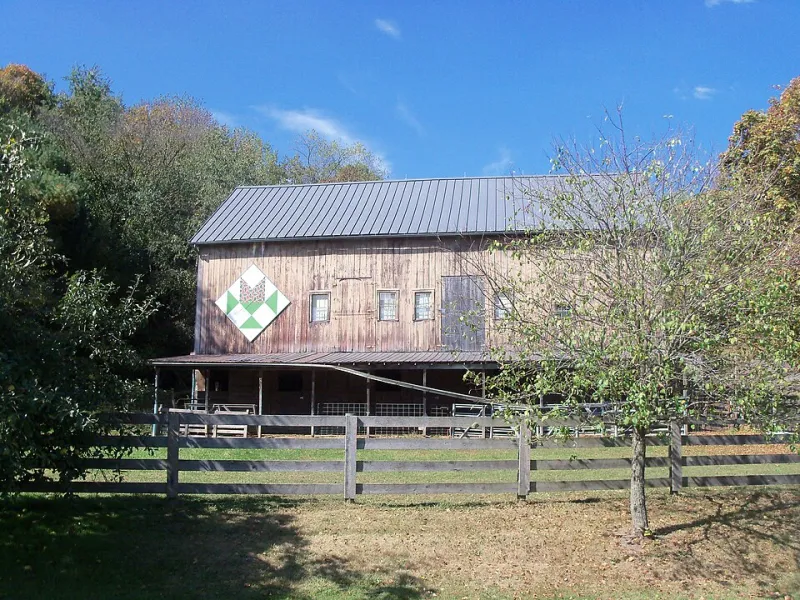
Photo: Roseohioresident, CC BY-SA 4.0, via Wikimedia Commons
There is a stretch of road in Adams County, Ohio, where the tobacco barns have stopped growing tobacco and started growing stars, log cabins, and double wedding rings. They are painted on eight-foot squares of plywood, bolted to the siding, and best seen at about 35 miles per hour with the windows down.
This is a barn quilt trail. If you have driven rural America in the past few years, you have probably passed half a dozen without registering what you were looking at. What began as one woman's tribute to her quilting mother has spread into a grassroots art movement covering more than 40 states and several thousand painted squares. No federal grant wrote the blueprint. County extension offices, arts councils, 4-H clubs, and a whole lot of retired farmers did.
It Started With a Promise to Mom
The origin story is refreshingly small. In 2001, Donna Sue Groves of Manchester, Ohio, wanted a way to honor her mother, Maxine, a lifelong quilter. Her plan was modest: one painted quilt square on the family's tobacco barn. Then neighbors asked if they could have one too. The county arts council got involved, a driving map got printed, and the first official trail, roughly twenty squares through Adams County, was born.
Adams County still holds one of the densest concentrations in the country and remains the movement's spiritual capital. But the model traveled fast. Wisconsin, Iowa, Kentucky, Tennessee, North Carolina, Michigan, Virginia, and dozens of counties in between now maintain their own routes. Some trails are twenty squares. Some are two hundred.
The economics are not complicated. A painted barn quilt runs a few hundred dollars in materials, needs no permits, requires no staff, and cannot be shipped overseas. For a rural county hunting for something to hang a tourism economy on, that is about as low a barrier as exists.
What You Are Actually Looking At
The squares are typically 8x8 feet, built from marine-grade plywood or aluminum composite, primed, painted in exterior latex, and sealed against UV. Designs follow traditional quilt blocks: Ohio Star, Log Cabin, Bear Paw, Goose in the Pond, Double Wedding Ring. A growing number are original compositions, and a few are frankly baffling, which makes them more interesting, not less.
Each square is numbered and appears on a printed map or a county trail app. Many properties add a story: the family name, the year the barn went up, why that pattern matters to that household. Others are pure decoration. Both are fine.
One thing worth saying plainly: the popular legend that quilt patterns served as a secret code on the Underground Railroad is not supported by historians, who have been fairly blunt on the subject. The trail celebrates a genuine craft tradition and does not need a myth bolted onto it.
Four Trails That Earn the Drive
Adams County, Ohio. The original. Grab a paper map at the visitor's bureau in West Union, then work the back roads between Manchester, Seaman, and Winchester. Pair it with a winery stop and a plate of something fried.
Green County, Wisconsin. Rolling dairy country southwest of Madison, heavy on Swiss and Norwegian heritage, with squares mounted on barns that have been in the same family for five generations. Best in early October when the corn goes bronze.
Ashe County, North Carolina. High country, cool nights, and a trail woven through Christmas tree farms and old tobacco ground. Combine it with the Blue Ridge Parkway and a night in West Jefferson.
Grundy County, Iowa. Flat, black, and beautiful in its own way, corn-and-beans country where the quilt squares read as bright interruptions against a horizon that runs forever. Excellent gravel-road driving.
If none of those are close, search your state plus barn quilt trail. There is probably one within an hour, whether you live near Kansas, Minnesota, Pennsylvania, West Virginia, Oregon, or Texas.
How to Drive One Without Being a Nuisance
These squares hang on working farms, not in a sculpture garden. A few house rules:
- Stay out of driveways and lanes unless a sign invites you in. A tractor rolling out of a barn cannot stop for your hatchback.
- Pull fully off the road. Farm shoulders are narrow and soft, and a two-ton pickup around a blind curve is the real hazard out here.
- Ask before photographing people or animals. Most folks say yes. A few say no, and that is the deal.
- Do not climb, lean on, or open anything.
- Buy something. Gas, a sandwich, a jar of honey, a bundle of firewood. The trail exists to keep money in the county, and you are the mechanism.
Why It Works
Barn quilts are a rare thing: a tourism product that fits the place it sits in. No parking garage, no festival permit, no farm turned into a theme park. They simply give you a reason to point the car down a road you would otherwise skip, at a speed where you can actually see the fence lines. A county can install an entire trail for less than the cost of one interstate billboard.
Take a Saturday. Pick a route. Bring a paper map, because cell service gets thin. And drive slow. The whole thing only works at 35 miles per hour.